
The FOMC's Executive Committee, 1933 to 1955

Cathy Minehan, president of the Federal Reserve Bank of Boston from 1994 to 2007, once lightheartedly described the structure of the Federal Open Market Committee (FOMC) as "unwieldy—some might even say messy" (Minehan 1995). As many as nineteen Federal Reserve officials participate in each FOMC meeting: seven members of the Board of Governors and twelve Reserve Bank presidents (though only five presidents vote at any given time). Minehan went on to stress, however, that this structure can be understood as the result of a compromise that sought to create a single committee that adequately balanced power among the different parts of the Federal Reserve System: the Reserve Banks and the Board of Governors.
From 1933 to 1955 the FOMC experimented with a different organizational structure in which it delegated some of its decisionmaking to a smaller and perhaps less "unwieldy" five-member executive committee. In principle, the full FOMC made major policy decisions while the executive committee was a nimbler group that executed that policy. However, delineating the boundary between policy decisions and operational decisions was a matter of much debate. In 1955, Chairman William McChesney Martin led the FOMC to abolish the executive committee, arguing that the full committee should be involved in the decisions that had been delegated.
Roots in the Fed's formative years
The Reserve Banks first explored open market operations in the 1920s. Officials at the New York Fed, such as Benjamin Strong, led an effort to coordinate operations across Reserve Banks. At this time Reserve Banks were not required by statute to consult with one another before buying or selling assets. Strong recognized that uncoordinated operations by individual Reserve Banks could (and did) conflict with one another. One bank might sell securities while another purchased, causing the overall impact of the Federal Reserve Banks' actions on financial markets to be volatile and unexpected. The challenge was to find a degree of coordination acceptable to all the Reserve Banks and the Board.
Three approaches to coordination were taken from 1922 to 1933 in the form of three predecessor committees to the FOMC. The common challenge was balancing breadth of representation with operational efficiency.
The first of these committees had five members that represented the Reserve Banks: Boston, Chicago, Cleveland, New York, and Philadelphia, which were at the time five of the six largest Reserve Banks. The Federal Reserve Board abolished this committee, replacing it with a second chartered under its supervision with the same membership (Federal Reserve Board 1923). The third committee was known as the Open Market Policy Conference (OMPC). It included all twelve Reserve Banks, at the request of the banks that had not been members of the prior committees, but also set up an executive committee of five members (Federal Reserve Board 1930).1 In practice, New York had an especially important role in all these committees.
With this history in mind, the FOMC's choice to create a five-person executive committee upon the FOMC's organization in 1933 was consistent with operating structures up to that time. The initial structure of the FOMC in 1933 retained the same 12 bank membership. The FOMC was subsequently modified by the Banking Act of 1935 to its modern form in which Board members hold seven of the twelve seats. At its first meeting in 1936, this restructured FOMC again established an executive committee. This committee consisted of three Board members (in practice, the chairman, vice chairman, and one other member) and two Reserve Bank presidents (in practice, New York and one other).
The Role of the Executive Committee
The purpose of the executive committee at the FOMC and its predecessors was to bridge the gap between policy and operations by having a smaller, nimbler committee that could make frequent decisions.
This function went beyond just executing specific transactions. When the creation of the OMPC's executive committee was considered in 1930, the first proposal was that it would only execute purchases or sales that had been approved by Federal Reserve Banks and the Board. The five proposed members of the executive committee objected to such limited authority (Federal Reserve Board 1930b, p. 4). Philadelphia Fed officials commented that such a committee would be in a "position little better than that of a broker or dealer." Instead, the executive committee members successfully pushed for broader authority to initiate transactions on its own accord in order to implement the OMPC's policy. Fed officials wanted to avoid having to call the full conference to approve specific transactions. (Conference of Governors Minutes, September 24, 1930; OMPC Minutes, September 25, 1930).
The need for an executive committee also reflected the cost of travel and communications at the time, which made it difficult for Fed officials from all over the country to meet more frequently. From 1933 to 1955, the FOMC met about six times a year on average. On the eve of the executive committee's elimination in 1955, the FOMC had been meeting only four times a year. (Statute only required the FOMC to meet at least quarterly.) In contrast, the executive committee met more frequently. By the late 1940s, the executive committee was meeting as often as every two weeks to monitor short-term financial developments and adjust the System's open market interventions. Because of travel costs, the fifth member of the FOMC's executive committee (not from the Board or New York) was usually from Philadelphia or Richmond, chosen because of their proximity to Washington (Daane 1970).
Delineating a sharp boundary between policy and operational decisions proved difficult. An important debate illustrating this problem occurred in 1952-1953. The question was whether the FOMC should buy and sell long-term Treasury securities or limit its actions only to the short end of the market. In 1951, the FOMC reached an Accord with the Treasury to stop its WWII-era policy of pegging the rate on long-term Treasury securities. Afterward, the FOMC had to decide what its new policy on long-term securities would be. There were concerns that the market was experiencing volatility as it adjusted to the Fed's post-accord policies. An ad hoc committee of the FOMC formed to study the issue recommended in 1953 that intervening in the long end of the market be limited unless market conditions deteriorated significantly, so that the market would not develop a reliance on the Fed.2 However, a harder question was who should make the decision that market conditions warranted such an intervention—the executive committee or the full FOMC?
During the debate, Allan Sproul (president of the New York Fed) was the leading advocate of retaining flexibility for the executive committee and the manager of the system open market account in New York. Sproul observed that "the real crux of the problem, which evidently bothered the ad hoc committee, is how to make an effective transit from policy to execution of policy, across an intervening area of mixed policy and execution." Sproul pointedly argued that "a committee cannot run the Account from day to day," a critique aimed at the full FOMC. He reasoned that operations involving long-term securities should be a matter of judgment that could be executed within the parameters of policy set out by the full committee (Sproul 1953).
The FOMC, however, decided in 1953 to restrict the executive committee to only operating in the short-term market. The FOMC retained the decision to operate in longer-term securities for itself. The vote reflected a sentiment that the choice of operating in longer-term securities was a policy choice, not just an operational one. It also reflected a small rift between the Board and New York. This episode proved to be a prelude to the elimination of the executive committee altogether in 1955. (Garbade 2021, p. 122; FOMC minutes, September 24, 1953, pp. 13 -31).
Eliminating the Executive Committee in 1955
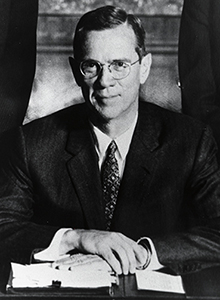
Chairman Martin was the leading voice in favor of eliminating the executive committee. After the 1952-1953 debate, he continued to consider the role of the executive committee, and by March 1955 he proposed that the FOMC consider the subject carefully at an upcoming meeting (FOMC Minutes, March 2, 1955, p. 36). In June, Martin stated that he viewed the executive committee structure as having created an environment in which some Reserve Bank presidents were out of touch with economic and financial developments that might affect policy. Martin described the FOMC as "the heart and core of the Federal Reserve System" and emphasized "the desirability of having the full Open Market Committee take the responsibility for decisions not only of policy but also as to open market operations." (FOMC Minutes, June 22, 1955, p. 3).
A related criticism of the executive committee was that it concentrated power beyond what was intended in the Federal Reserve Act. In particular, critics in Congress such as Rep. Wright Patman viewed the New York Fed as having outsized influence on the executive committee and therefore the Fed as a whole. New York Fed President Allan Sproul summarized such criticism: "Congress gave this great power of directing open market operations of the Federal Reserve Banks to twelve men, the twelve men gave it to five, the five gave it to one, and it ended up in the hands of Wall Street" (FOMC minutes, June 22, 1955, p. 7). Sproul thought the criticism unfair, though, since by 1955 all members of the full committee were invited to the executive committee meetings. He also defended the executive committee as helpful if emergency conditions were to develop.
Ultimately, the influence of Chairman Martin won out, and the FOMC voted to abolish the committee in June 1955.
The official press release announcing the end of the executive committee in 1955 was brief and focused on mundane travel costs. "So long as travel facilities were less swift and certain than they are now, the Executive Committee was an administrative convenience" (Federal Reserve Bulletin, July 1955, p. 756). Unstated was the more fundamental goal of increasing the participation of Reserve Bank presidents and restoring Congress's intended balance of power in the Fed System.
The end of the executive committee had a few important implications.
First, the FOMC began meeting more frequently. In 1954, the full FOMC had met only once a quarter, the minimum required by statute. In 1956, the first full year after the executive committee was eliminated, the FOMC met twenty times. Over the next couple of decades, the FOMC's meeting frequency gradually declined until settling on eight regularly scheduled meetings a year in the early 1980s.
Second, the full FOMC became much more involved in day-to-day policy. Looking back in 1964, Chairman Martin viewed the reform as having been successful in broadening expertise across members of the FOMC: "we believe that this means of bringing in the other seven presidents and their top assistants has contributed greatly to the changeover that occurs once a year when we have rotation by law in the voting members of the Committee. We think that this has broadened knowledge of the activities of the System, and that this has been an effective clearinghouse within the System for our operations" (Martin 1964, p. 36). Historically, Reserve Bank presidents had commonly been financiers and many had focused on payment and discount window administration. After 1955, Reserve Bank presidents became more involved in monetary policy on a regular basis and increasingly were chosen for their backgrounds as economists rather than financiers. In addition, Reserve Banks grew substantial research departments to support their presidents' roles on the FOMC (Bordo and Prescott 2023).
Third, the New York Fed's influence over monetary policy declined somewhat, though New York retained a unique role in the System. From the first days of the System's operations, New York had developed valuable expertise on financial markets and took on the role of interacting with markets on behalf of the System, reflecting that major financial market participants were concentrated in New York City. Historically, New York had been "the leading force in the determination of open-market policy" (Goldenweiser 1951, p. 278). Nevertheless, New York continued to run the System Open Market Account on behalf of all the Reserve Banks and is the only Reserve Bank with a permanent seat on the FOMC.
The executive committee was one solution to the question of how to make important operational decisions in the execution of monetary policy. In practice, calling the FOMC frequently was impractical, especially given historic limits on communications and travel at the time. However, the executive committee structure also reflected the New York Fed's importance stemming from its uniquely strong knowledge of financial market conditions. Ultimately, Chairman Martin restored operational control to the full committee in order to faithfully implement the Federal Reserve's distributed power structure.
Endnotes
- 1 The first committee was the Committee of Governors on Centralized Execution of Purchases and Sales of Government Securities by Federal Reserve Banks (1922-1923). The second committee was the Open Market Investment Committee (OMIC, 1923-1930). See Meltzer (2003, chapter 4).
- 2 The report of the ad hoc committee is discussed by Garbade (2021) and was reprinted in Congressional Hearings in 1954; see U.S. Congress (1954, p. 257).
References
Board of Governors of the Federal Reserve System. "July 1995." Federal Reserve Bulletin. Available on FRASER.
Bordo, Michael D. and Edward S. Prescott. (2023) "Federal Reserve Structure and the Production of Monetary Policy Ideas." Available online.
Daane, J. Dewey. (1970) "Perspective on Monetary Policy." Economic Quarterly, Federal Reserve Bank of Richmond. Available on FRASER.
Federal Open Market Committee. Meeting Minutes, Transcripts, and Other Documents, 1953-1955. Available on FRASER.
Federal Reserve Board. (1923) Letter X-3689: Policy Governing Open Market Purchases by Federal Reserve Banks and the Administration thereof. Available on FRASER.
Federal Reserve Board. (1930) Letter X-6484: Open Market Procedure. Available on FRASER.
Federal Reserve Board. (1930b) Letter X-6525: Open Market Policy Committee. Available on FRASER.
Garbade, Kenneth D. (2021) After the Accord: A History of the Federal Open Market Operations, the US Government Securities Market, and Treasury Debt Management From 1951 to 1979. Cambridge.
Goldenweiser, E. A. (1951) American Monetary Policy. McGraw-Hill.
Martin, William McChesney, Jr. (1964) Testimony. Hearings: The Federal Reserve System After Fifty Years. Available on FRASER.
Meltzer, Allan. (2003) A History of the Federal Reserve, Volume 1: 1913-1951. University of Chicago Press.
Minehan, Cathy. (1995) "Reflections of a Freshman FOMC Member." Available on FRASER.
Open Market Policy Conference for the Federal Reserve System. "Meeting, September 25, 1930," Minutes of the Meetings of the Open Market Policy Conference. Available on FRASER.
Sproul, Allan. (1953) Extract from personal and confidential memorandum dated February 18, 1953, from Mr. Sproul, Vice Chairman, Federal Open Market Committee, and President, Federal Reserve Bank of New York, to all members of Federal Open Market Committee and President of Federal Reserve Banks, on the Report of the Ad Hoc Subcommittee on the Government Securities Market. Available on FRASER.
United States Congress. (1954) Hearings, Joint Economic Committee, Subcommittee on Economic Stabilization. United States Monetary Policy: Recent Thinking and Experience. Available on FRASER.
Published August 14, 2026. Jonathan Rose contributed to this article. Please cite this essay as: Federal Reserve History. "The FOMC's Executive Committee, 1933 to 1955." August 14, 2026. See disclaimer and update policy.
 X
X  facebook
 email
email